


There are still people in the world of innovation who insist on peddling the notion that thinking “outside the box” is the key to getting to a better place. This is what Harry Houdini used to think, and look what happened to him. He actually died of appendicitis rather than unsafe escapology – but the point remains. Sometimes you need to accept the reality that you’re stuck inside a box, so better to embrace the positives of the situation rather than trying to escape it.
In fact, this is something to accept not only sometimes, but every time you’re faced with an innovation brief or a stretching growth challenge. Why? Because in our experience, there is always a box in which you need to operate. The box is defined by the restrictions that real life has a habit of throwing at us. Sometimes they’re perceived rather than real, so it’s important to pull apart the genuine constraints from the genuine pains.
These restrictions can take many different forms and vary from one client challenge to the next. They can be internal – driven by the strategy, commitment, structure or capabilities of the organisation – or external, specific to the category or market in which you are innovating.
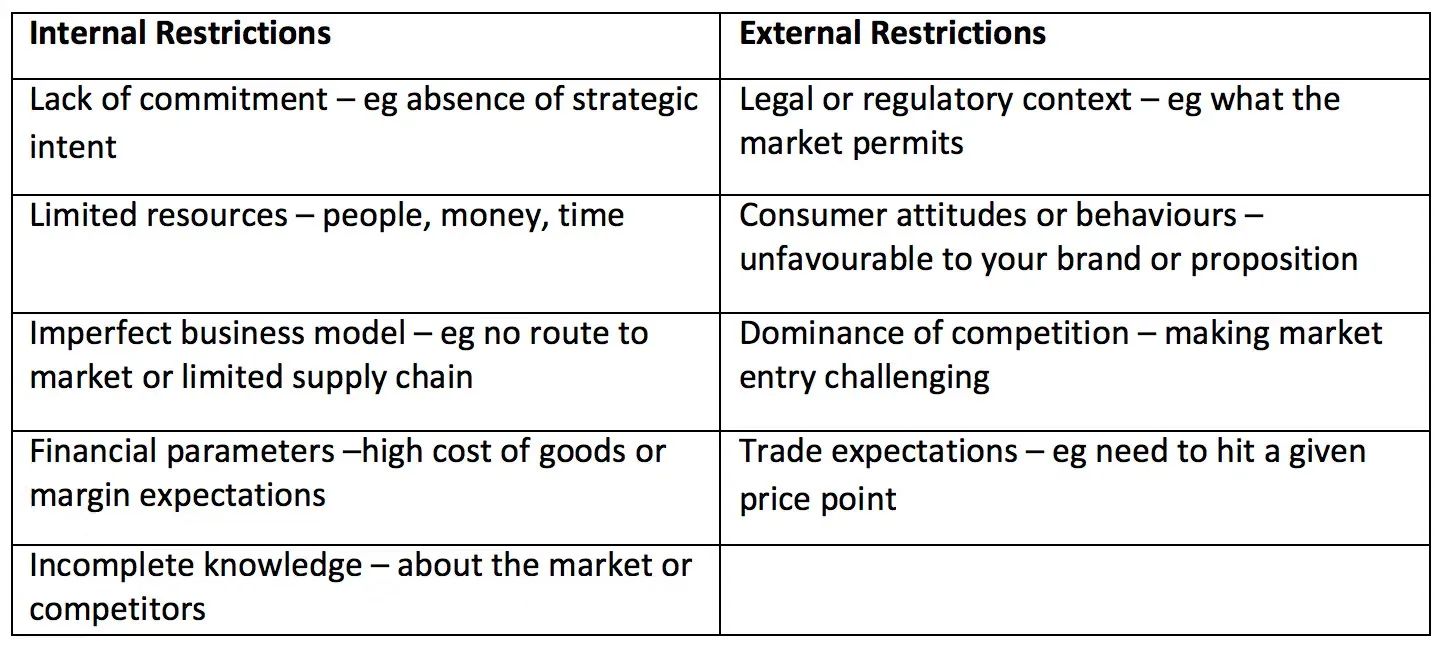
Given these restrictions are inevitable, it is far more productive to use them to define your box and then think creatively within it, rather than to ignore them by thinking “outside the box”. Being consciously constrained can be a positive for innovation teams – forcing them to take a problem-solving approach to the brief rather than adopting less pragmatic and less focused blue-sky thinking.
A few years back we examined the innovation success rates of different divisions within a multinational company. We were somewhat surprised to find that the business unit with the fewest resources, operating in the most difficult markets where the business had limited infrastructure, actually had the strongest innovation track record. The reason? They turned their constraints into a positive, embraced them, and learned to master the principles of restricted innovation.
Restricted innovation is the practice of innovating within the box. It is more pragmatic, more productive and leads to more effective outputs. In our experience, it is also a far more inclusive approach that leverages functional expertise across the organisation and engages introverts as well as the more extraverted creative types typically attracted to innovation roles.
Guidelines for restricted innovation
- Define your box – identify your genuine constraints and understand the implications
- Express your problems – define your innovation briefs in terms of the problems to solve
- Engage the experts – find the individuals (internal and external) with the relevant expertise
- Seek simple solutions – given the restraints, simple solutions executed well are often the most effective
- Be prepared to accept the impossible – sometimes the constraints are too significant to innovate around; be prepared to flag it and consider relaxing one or more constraints or changing the brief

The individuals that thrive in a restricted innovation environment may be different from the typical highly extraverted personality types usually attracted to innovation roles. More commercially astute and functionally knowledgeable individuals have much to offer in these situations – and the composition of the project team can be shaped by the nature of the restrictions faced. We have worked with clients’ technical teams when constraints have revolved around patents and product specifications, and with supply chain specialists when constraints have been linked to production capability.
Our approach to innovation and helping clients achieve their stretching growth ambitions is grounded in the principles of restricted innovation. Our belief, based on experience, is that every innovation challenge is constrained and needs tackling from inside the box. What’s more, the restrictions only seem to be increasing over time – so innovation teams need to learn how to thrive under these conditions, and avoid the temptation to try to escape them.
Justin Wright
Managing Partner
Mangrove