
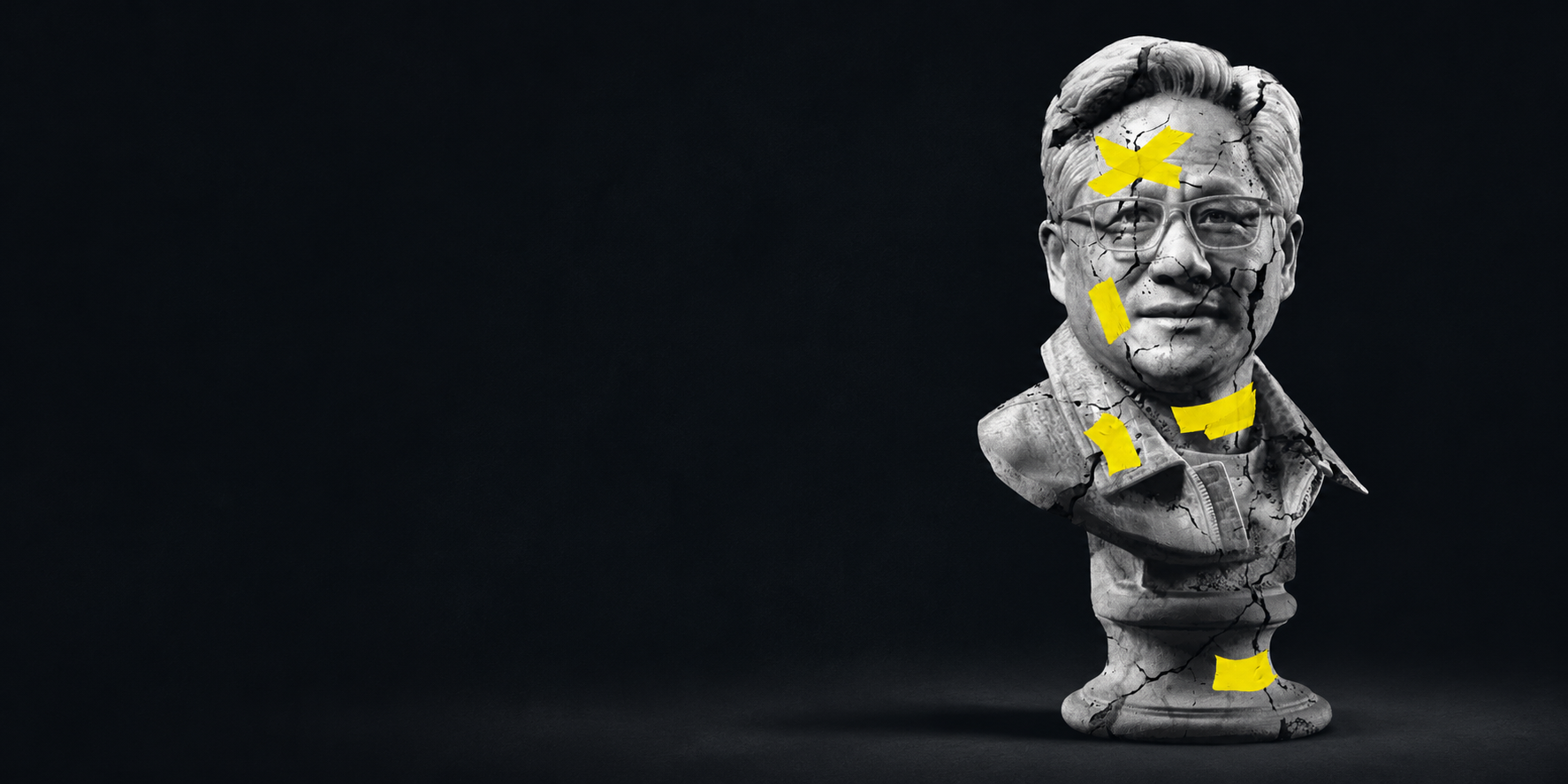

Exceptional leaders can create extraordinary businesses. The ultimate test of leadership is whether the organisation can sustain performance without them.
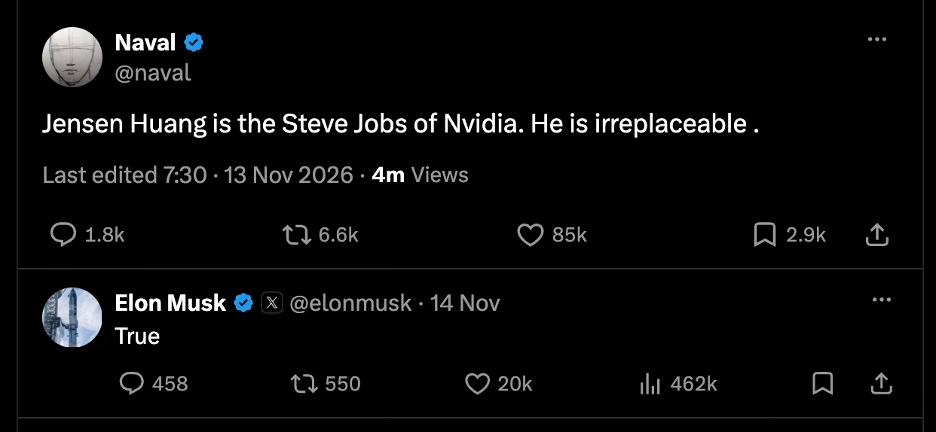
Within days of Jensen Huang’s resignation as Nvidia’s CEO, more than 180,000 people had signed a campaign calling for his return. Over 8,800 of them identify as current Nvidia employees.*
It’s a remarkable show of loyalty. Huang spent 33 years turning Nvidia into the company powering the AI revolution. He had the vision to anticipate a market, the courage to make bold bets and the ability to mobilise an organisation behind an extraordinary ambition. He made a lot of people successful along the way, and they haven’t forgotten it.
Now Nvidia has brought him back. The board reversed its position, pressure to reinstate him mounted and the company’s share price surged on the news.
It may prove to be the right commercial decision. But it also raises an uncomfortable question: has Huang built an extraordinary organisation, or one that remains extraordinarily dependent on him?
A champion team, or a team relying on its champion?
In elite sport there’s a saying: “a champion team will always beat a team of champions.”
Nvidia has just had an opportunity to show which one it is. And the response suggests it may be a team still relying on its champion.
The campaign shows how much respect people have for what he built. What it can’t tell you is whether they want him back or need him back.
But the extraordinary pressure to restore him suggests that, for many, the distinction barely mattered. The assumption was that Nvidia would be stronger with Huang back at the centre.
That doesn’t mean the organisation couldn’t have succeeded without him. It was never given much time to prove it. But perhaps that’s the point. The reaction reveals just how difficult it is for people to imagine Nvidia without its founder. For a business of its scale and success, that should give us pause.
Why brilliant leaders can build fragile organisations
Huang ran an unusually flat structure, with dozens of direct reports and few formal one-to-ones. It kept Nvidia fast and close to its leader’s thinking. It also meant much of the organisation ran through one person.
This is the trap exceptional leaders fall into. Their judgement is so good that the organisation learns to wait for it. Decisions travel up rather than being made close to the work. The people around them become excellent at executing and less practised at leading. Performance looks extraordinary right up to the moment the leader steps away.
The danger is that what looks like a high-performance culture may actually be a culture built around one high-performing individual. And the longer that model delivers success, the harder it becomes to challenge.
It’s a pattern we see well beyond Silicon Valley, in founder-led businesses and in any team built around a star. And it’s becoming more relevant, not less. As AI tempts organisations to strip out management layers, many risk removing the very environments where future leaders develop.
What a champion team looks like
At Mangrove, we believe sustained performance comes from aligning ambition with commitment. It’s the foundation of our Stretchonomics approach. An exceptional leader can supply the ambition. Sustaining it takes a commitment to building the capability around them: developing leaders at every level, pushing decisions to the people closest to the work, and building a performance culture the whole team owns rather than one person carries.
You can usually tell which kind of organisation you’re in without looking at a single metric. Walk the floor and you can see it. Watch people’s body language and behaviour. Do they move with purpose, like they always know what needs doing, or are they waiting to be told? Stop anyone and ask what the mission is, what outcomes they’re responsible for and how their work ladders up to it. In a champion team, everyone can answer. In a team relying on its champion, the answers all lead back to one person.
The test every leader should run
Few leaders will ever face a test this public. But every leader can run a version of it privately. If you stepped away for six months, which decisions would stall? Who would people look to? Would performance hold, dip, or quietly improve?
The answers say more about your leadership than any result you delivered while you were there.
Huang is back, and Nvidia may well continue to thrive under his leadership. But his return leaves a question hanging over one of the world’s most successful businesses: has its extraordinary performance come at the expense of building an organisation that can succeed independently of him?
The real test of Huang’s leadership isn’t what Nvidia can achieve with him back at the centre. It’s whether he now builds the capability for it to thrive when he eventually steps away.
The greatest leaders aren’t the ones their organisations can’t live without. They’re the ones who build organisations that don’t need them.
*Campaign figures reported by Reuters, 16 November 2026. Employee affiliations are self-reported and unverified.